
Notes from the Field 10 - I'm Not Down.
Session 03 - Pyre

Session 03 - Pyre
Four days before my 17th birthday, Sinéad O’Connor took a stand that stunned the world.
Her album I Do Not Want What I Haven’t Got had been in my walkman for months, breaking my heart on the bus to speech meets, fueling my basement solo-dance parties, and reigniting my love of Prince.
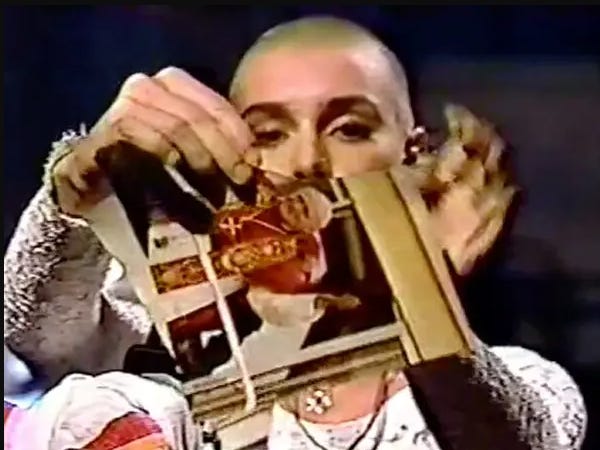
She commanded the stage, head shaved, face somber, her beautiful blue eyes burning a hole through the camera as she said “Fight the real enemy.” and tore a photo of Pope John Paul II in half on live TV.
I sat on the couch in my parent’s living room not breathing, letting my pint of Ben & Jerry’s Cherry Garcia melt.
What I didn’t know yet, what none of us knew, was what she was actually doing up there. She performed Bob Marley’s “War” a cappella, and she changed the lyrics. Where Marley sang about racism, Sinéad sang about child abuse. She built the whole thing as a delivery mechanism before any of us understood what was being delivered.
The photo wasn’t a prop. It had hung in her mother’s bedroom. She took it down from the wall the day her mother died and had been waiting for the right moment to destroy it. October 3rd, 1992 was the right moment.
Lorne Michaels ordered the applause sign turned off. The air went out of the studio. The audience sat in complete silence. Sinéad removed her earbuds, blew out the candles, and walked offstage.
Then the world lost its mind.
Joe Pesci said he would have slapped her. Frank Sinatra said he’d kick her ass. She was banned from NBC for life. Thirteen days later, she took the stage at Bob Dylan’s 30th anniversary concert at Madison Square Garden. A bill that included George Harrison, Neil Young, Tom Petty, Johnny Cash, Stevie Wonder, Eric Clapton, Lou Reed, and Tracy Chapman. Kris Kristofferson introduced her: “I’m real proud to introduce this next artist whose name became synonymous with courage and integrity. Ladies and gentlemen, Sinéad O’Connor.”
The boos were immediate and enormous.
The band tried to start Dylan’s “I Believe in You.” Drowned out. The promoters sent Kristofferson back out, to get her off the stage. He refused. He walked out, put his arm around her, and whispered the title of one of his own songs in her ear: “Don’t let the bastards get you down.”
She looked at him and said: “I’m not down.”
She stopped the band. Unaccompanied, she screamed out “War” again. Same song, same stage, same truth, and ran offstage into Kristofferson’s arms. He embraced her. He later wrote her a song called “Sister Sinéad.”
When the concert was released on home video, her entire performance was cut and replaced with rehearsal footage. They tried to erase her from the record. Literally.
She was also right about everything.
Nine years after that SNL broadcast, the Boston Globe began publishing the reports that the Catholic Church in the United States had been systematically covering up child sexual abuse by priests for decades. That investigation became Spotlight. It won the Oscar for Best Picture. In 2010, Pope Benedict XVI issued a public apology to victims of abuse in Ireland. The Church caught up eventually. Sinéad had been standing in that truth alone for nearly a decade.
She said later, in her memoir Rememberings: “I feel that having a number-one record derailed my career and my tearing the photo put me back on the right track. I wasn’t born to be a pop star. You have to be a good girl for that. After SNL, I could just be me.”
She built a pyre on live television. She decided what went into it. She decided what the fire was for. And what remained when the ash settled was exactly her.
That’s this whole next Perimeditation session.
If you’ve listened to “Three Babies”, and I mean really listened, you know what it means to hold grief in the body for something most people will never acknowledge you lost. If “Black Boys on Mopeds” has ever caught in your throat, you know what it costs to refuse to look away from what’s true when everyone around you is performing a different story.
Sinéad O’Connor knew what her gut was telling her. She didn’t override it. She built a pyre out of it instead.
This session was made in her shadow. Every word of it.
- erin
Session 03 - Pyre
SONIC INFLUENCES:
The binaural beat for Pyre runs at 8 Hz, the theta/alpha border, delivered at 200 Hz in the left ear and 208 Hz in the right. If you’ve been with me since Marrow, you’ve noticed the frequencies rising: 2 Hz at the root, 5 Hz at the sacral, 8 Hz here. We’re ascending through the body. The frequencies are doing it too.
PLEASE LISTEN TO IT WEARING HEADPHONES
The music was built in Suno using Velvet Underground, Mazzy Star, and Cigarettes After Sex as reference points. What came out sounded like Angelo Badalamenti scoring a Lynch film, smoky, sexy, a little dangerous. Already burning before you press play. That was exactly right.