

LINER NOTES
On the music
Sonic influences: Sufjan Stevens (Come on feel the Illinoise), Radiohead (Kid A), Fleet Foxes (self-titled), and Devotchka’s song “The Winner Is”. The happy accident echo present in Session 01: Marrow has been reduced significantly. Marrow’s echo was the cave. Confluence is the mouth of it.
On the session
Session 02: Confluence runs 46 minutes. The first and last five minutes are music and binaural tones only; narration runs from minute 5 through minute 40. Headphones are required for the binaural effect to work.
On the frequencies
The binaural beat in Confluence is set at 5 Hz, low theta range, produced by a 200 Hz tone in the left ear and a 205 Hz tone in the right. Your brain perceives the difference between them as a third tone that doesn’t exist in the room. Theta (4–8 Hz) is associated with flow states, creative access, emotional processing, and the liminal space between waking and sleep. You can’t hear 5 Hz directly, but the brain will sync to it over time. This is why the first five minutes of the session are music only. The nervous system needs the on-ramp before the voice arrives.
Notes from the Field 09 - Baptism by Fuzz
When there wasn’t any holy water.
6/14/26
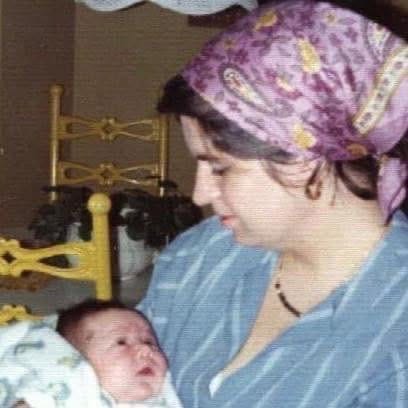
I have a three-inch scar under my right ribcage that I have no memory of receiving. It has been there since I was ten days old. Everything I know about how it got there I know because my parents told me. And because they thought I was dying, my mother, in the back seat of a yellow 1972 Volkswagen Bug, baptized me with fuzz she pulled off of my blanket.
That is the story as I know it, which means it is not really a story I know at all. I am the unreliable narrator of my own origin. What I have is the scar I can touch but not remember, their words, and a theology that said the fuzz was sufficient.
My mom was twenty-three years old. My dad was twenty-six. They had moved to Louisville after my dad finished his Masters in Audiology. His career taking them even further south than their alma mater in Bloomington, IN, while their families lived four or five hours north. Which is the kind of distance that feels manageable until it doesn’t. They were new to the city, and I was their first born. Eight pounds, twelve ounces. Named after one of the daughters from The Waltons. My mom did her whole labor au natural, which is a detail I hear differently now, than I did when I was younger, having tried and failed at that myself. I understand it in my body rather than just my head. She was twenty-three years old and she did it all by herself. I came out healthy. Everyone was so happy. Everyone went home.
And then I stopped thriving.
My mom was exclusively breastfeeding, and I was physically returning everything she offered. This went on for ten days. Ten days of watching a baby who weighed eight pounds lose weight she couldn’t afford to lose, getting weaker and less responsive by the hour. My dad’s whole professional life is the science of how the body receives signals. The auditory system, the pathway from the world into the brain. And he was there watching his daughter lose the ability to receive anything at all, the most basic thing a body can signal. I am still here. My grandparents, their college friends, their support system, were all four or five hours north. My parents were alone with a baby who was failing, in a city that wasn’t home yet, making decisions nobody had prepared them for.
My folks had both grown up in the Lutheran Church, Missouri Synod. In that tradition, baptism is not a formality or a celebration. It is the entry point, a sacrament through which a person is cleansed and received into the covenant, the act that opens the door to what the scripture promises after this life. While at the time, my parents weren’t exactly churchgoers, that ideology had been woven into their fabric. My parents may not have believed this completely, but like the way you believe the things instilled in you by the people who loved you. And they were watching their ten-day-old firstborn become unresponsive in their apartment, in a city they hadn’t yet made their own, and they weren’t going to take anything to chance.
There was no church. No pastor. No holy water in the car when they headed for the hospital.
My mom reached for my blanket. She pulled off a piece of fuzz. And in the back seat of their little yellow VW Bug, she baptized me.
The theology here is worth sitting with, because it isn’t simple and it isn’t sentimental. Sacramental traditions have always grappled with what happens when the proper elements are unavailable under emergency conditions. When a dying person needs last rites and there is no oil, when a baby needs baptism and there is no water. The tradition usually lands in the same place: the element matters, because the Word behind the element matters more. What makes the sacrament real is the faith and intention of the person delivering it, not the vessel it travels through. The fuzz was her substitution, standing in for water the way crackers and grape juice or bread and wine stand in for flesh and blood. The church will support a contingency plan for emergencies. My mom found it in the back seat of their little car.
A couple months later, when their fears subsided, my parents asked one of their childhood pastors if it counted. It did. So, I was never formally baptized in the church. I was baptized by my mother, with fuzz from my blanket, and symbolic or not, that is as real as it gets.
The diagnosis was pyloric stenosis. The valve between my stomach and small intestine had thickened to the point that almost nothing could pass through. My body was actively rejecting nourishment because something was wrong anatomically. An emergency surgery later, I was going to be okay. The scar and the story are the only evidence, fifty years later. It’s deep, and definitely not what the same surgery, now performed almost non-invasively, leaves behind. I’ve always known it even though I have no memory of it.
I sometimes think about what those ten days must have been like for my parents. Not for me, though I’m guessing it wasn’t exactly fun for me either. I was too new to have the ability to retain it as memory. But for them. My mom, twenty-three and postpartum, watching something go wrong with the person she had just brought into the world. My dad, twenty-six, his audiology training completely useless for this specific emergency, alone with his wife in a city they hadn’t figured out yet, watching his daughter lose ground.
And in that moment of desperation, my sweet little momma reached for my blanket.
That reach is where I return to. The theology gave her a framework, and when it confronted her in the back seat of their yellow VW Bug, she didn’t debate whether the conditions were right. She grabbed the only thing available and she used it. She performed a two-thousand-year-old sacrament with fuzz, on their way to a hospital in Louisville, because she was twenty-three years old and she was not going to let the absence of the right medium be the last word on whether her daughter was going to be okay.
I wonder whether there is a version of that story that lives on in my body. A ten-day-old nervous system is just forming. It’s taking in the world through channels that have no reference point, no experience to pull from to interpret what it perceives. What it receives, it receives pure: temperature, pressure, sound, smells, pain, pleasure. I don’t know if those ten days influenced anything about how I see or feel the world, or whether the surgery changed anything I can measure. What I know is that before my body was repaired, it received my mother’s intention, traveling through fuzz, because she found a way. I don’t know how my nervous system registered that. I suspect it is filed somewhere below language, or memory. In the infrastructure that got built before it could be reconciled.
This essay is an homage. To my twenty-three-year-old mom, who reached for the blanket. To my dad, driving their car in the dark, in a frenzy, through a city that wasn’t home. Twenty-six years old and holding on. To the two of them, alone and young and doing it anyway. Together, and for the common cause of their daughter who they already loved beyond measure.
I came from that. My scar came from that. The instilled theology bending to love in a moment that must have felt unimaginable came from that. The pastor confirming it, and all of it coming from two young people who had never been put in a position like that and doing it like champions.
It substantiates the case for and beauty of improvised grace. And it turns out I was a recipient long before I could say thank you. Thank you, Mom & Dad. I love you!
— erin


